WP_Query Object
(
[query] => Array
(
[post_type] => tribe_events
[posts_per_page] => 5
[post_status] => publish
[orderby] => Array
(
[post_date] => ASC
[tec_event_start_date] => ASC
)
[order] => DESC
[tax_query] => Array
(
[0] => Array
(
[taxonomy] => post_tag
[field] => term_id
[terms] => 1544
)
)
[meta_query] => Array
(
[tec_event_start_date] => Array
(
[key] => _EventStartDate
[compare] => EXISTS
)
[tec_event_end_date] => Array
(
[key] => _EventEndDate
[value] => 2026-04-17 15:53:56
[compare] => >=
[type] => DATETIME
)
)
)
[query_vars] => Array
(
[post_type] => tribe_events
[posts_per_page] => 5
[post_status] => publish
[orderby] => Array
(
[post_date] => ASC
[tec_event_start_date] => ASC
)
[order] => DESC
[tax_query] => Array
(
[0] => Array
(
[taxonomy] => post_tag
[field] => term_id
[terms] => 1544
)
)
[error] =>
[m] =>
[p] => 0
[post_parent] =>
[subpost] =>
[subpost_id] =>
[attachment] =>
[attachment_id] => 0
[name] =>
[pagename] =>
[page_id] => 0
[second] =>
[minute] =>
[hour] =>
[day] => 0
[monthnum] => 0
[year] => 0
[w] => 0
[category_name] =>
[tag] =>
[cat] =>
[tag_id] => 1544
[author] =>
[author_name] =>
[feed] =>
[tb] =>
[paged] => 0
[meta_key] =>
[meta_value] =>
[preview] =>
[s] =>
[sentence] =>
[title] =>
[fields] => all
[menu_order] =>
[embed] =>
[category__in] => Array
(
)
[category__not_in] => Array
(
)
[category__and] => Array
(
)
[post__in] => Array
(
)
[post__not_in] => Array
(
)
[post_name__in] => Array
(
)
[tag__in] => Array
(
)
[tag__not_in] => Array
(
)
[tag__and] => Array
(
)
[tag_slug__in] => Array
(
)
[tag_slug__and] => Array
(
)
[post_parent__in] => Array
(
)
[post_parent__not_in] => Array
(
)
[author__in] => Array
(
)
[author__not_in] => Array
(
)
[search_columns] => Array
(
)
[meta_query] => Array
(
[tec_event_start_date] => Array
(
[key] => _EventStartDate
[compare] => EXISTS
)
[tec_event_end_date] => Array
(
[key] => _EventEndDate
[value] => 2026-04-17 15:53:56
[compare] => >=
[type] => DATETIME
)
)
[ignore_sticky_posts] =>
[suppress_filters] =>
[cache_results] => 1
[update_post_term_cache] => 1
[update_menu_item_cache] =>
[lazy_load_term_meta] => 1
[update_post_meta_cache] => 1
[nopaging] =>
[comments_per_page] => 50
[no_found_rows] =>
)
[tax_query] => WP_Tax_Query Object
(
[queries] => Array
(
[0] => Array
(
[taxonomy] => post_tag
[terms] => Array
(
[0] => 1544
)
[field] => term_id
[operator] => IN
[include_children] => 1
)
)
[relation] => AND
[table_aliases:protected] => Array
(
[0] => wp_term_relationships
)
[queried_terms] => Array
(
[post_tag] => Array
(
[terms] => Array
(
[0] => 1544
)
[field] => term_id
)
)
[primary_table] => wp_posts
[primary_id_column] => ID
)
[meta_query] => WP_Meta_Query Object
(
[queries] => Array
(
[tec_event_start_date] => Array
(
[key] => _EventStartDate
[compare] => EXISTS
)
[tec_event_end_date] => Array
(
[key] => _EventEndDate
[value] => 2026-04-17 15:53:56
[compare] => >=
[type] => DATETIME
)
[relation] => AND
)
[relation] => AND
[meta_table] => wp_postmeta
[meta_id_column] => post_id
[primary_table] => wp_posts
[primary_id_column] => ID
[table_aliases:protected] => Array
(
[0] => wp_postmeta
[1] => mt1
)
[clauses:protected] => Array
(
[tec_event_start_date] => Array
(
[key] => _EventStartDate
[compare] => EXISTS
[compare_key] => =
[alias] => wp_postmeta
[cast] => CHAR
)
[tec_event_end_date] => Array
(
[key] => _EventEndDate
[value] => 2026-04-17 15:53:56
[compare] => >=
[type] => DATETIME
[compare_key] => =
[alias] => mt1
[cast] => DATETIME
)
)
[has_or_relation:protected] =>
)
[date_query] =>
[request] => SELECT SQL_CALC_FOUND_ROWS wp_posts.ID
FROM wp_posts LEFT JOIN wp_term_relationships ON (wp_posts.ID = wp_term_relationships.object_id) INNER JOIN wp_postmeta ON ( wp_posts.ID = wp_postmeta.post_id ) INNER JOIN wp_postmeta AS mt1 ON ( wp_posts.ID = mt1.post_id )
WHERE 1=1 AND (
wp_term_relationships.term_taxonomy_id IN (1549)
) AND (
wp_postmeta.meta_key = '_EventStartDate'
AND
( mt1.meta_key = '_EventEndDate' AND CAST(mt1.meta_value AS DATETIME) >= '2026-04-17 15:53:56' )
) AND wp_posts.post_type = 'tribe_events' AND ((wp_posts.post_status = 'publish'))
GROUP BY wp_posts.ID
ORDER BY wp_posts.post_date ASC, CAST(wp_postmeta.meta_value AS CHAR) ASC
LIMIT 0, 5
[posts] => Array
(
[0] => WP_Post Object
(
[ID] => 92161
[post_author] => 1
[post_date] => 2026-04-17 09:31:04
[post_date_gmt] => 2026-04-17 09:31:04
[post_content] => Dear All,
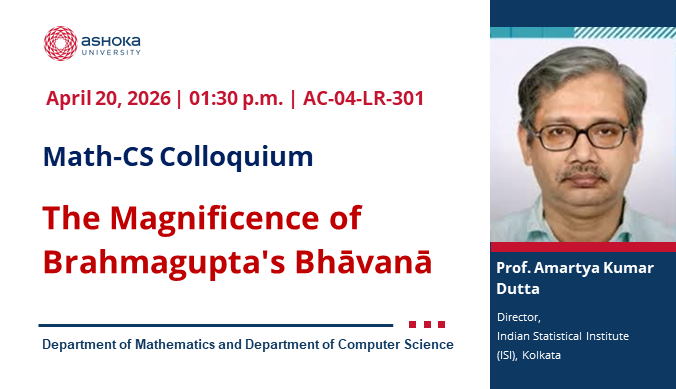
The Department of Computer Science and the Department of Mathematics invites you to a joint colloquium on "The Magnificence of Brahmagupta's Bh�van�" by Prof. Amartya Kumar Dutta, Director, ISI, Kolkata.
The details are as follows:
Abstract: In this talk we will try to give a historical perspective on a profound result in mathematics due to Brahmagupta (628 CE). The result is a certain ‘law of composition’ referred to in Indian mathematics by the great Sanskrit word bhÄÂ�vanÄÂ�. In mathematics, a law of composition combines (i.e., ‘composes’) twomathematical objects of a certain type to produce a third object of the same type. For instance, Brahmagupta’s composition law bhÄÂ�vanÄÂ� combines two solutions of a given equation to generate a third solution of the equation; it also combines two polynomial expressions of a particular type to yield another expression of the same type. While Brahmagupta’s bhÄÂ�vanÄÂ� is now a basic and useful result in modern number theory, its real greatness lies in its manifesting the very principle of composition in mathematics. The principle of composition lies at the heart of modern Abstract Algebra and Number Theory. A subsequent major landmark in number theory is Gauss’s composition law (1801) on ‘binary quadratic forms’, a generalisation of an aspect of Brahmagupta’s bhÄÂ�vanÄÂ�. Around the beginning of the present century, Fields Medalist Manjul Bhargava stunned the world of mathematics by his discovery of new ‘composition laws’, which simplify and provide far-reaching generalisations of Gauss’s law.
As a tribute to the work of Brahmagupta, a prominent mathematics magazine which is being published from January 2017 has been named Bh�van�. For the word bh�van� brings to our mind a brilliant mathematical concept from a bygone era and provides a link between one of the highest peaks of ancient Indian mathematics and one of the most celebrated achievements in contemporary mathematics.
About the Speaker: Prof. Amartya Kumar Dutta works in commutative algebra and affine algebraic geometry, with additional contributions to the history of mathematics. He is currently the Director of the Indian Statistical Institute (ISI), Kolkata, where he has spent nearly three decades in the Theoretical Statistics and Mathematics Unit. He obtained his Ph.D. in Mathematics from the Tata Institute of Fundamental Research in 1994 under S. M. Bhatwadekar, and has since built a sustained research program in algebra. His work focuses on structural questions, including affine fibrations, polynomial ring retracts, residual and stable coordinates, and Noetherian algebras. Over the years, he has also mentored and guided numerous students, contributing significantly to the development of the subject in India.
Alongside his research, Prof. Dutta has maintained a long-standing engagement with the history of mathematics, especially ancient Indian mathematical traditions. For over 25 years, he has delivered lectures and written articles on the history of science, and has taught courses on Indian mathematics and modern science at the Ramakrishna Mission Institute of Culture. His writings, including a continuing series in the magazine Bh�van�, reflect a distinctly algebraic perspective on the evolution of mathematical ideas. He is a recipient of the INSA Teachers Award, and the inaugural Satish C. Bhatnagar Award in History of Mathematics from the Indian Mathematical Society.
We look forward to your active participation.
[post_title] => Math - CS Colloquium
[post_excerpt] =>
[post_status] => publish
[comment_status] => closed
[ping_status] => closed
[post_password] =>
[post_name] => math-cs-colloquium
[to_ping] =>
[pinged] =>
[post_modified] => 2026-04-17 09:31:04
[post_modified_gmt] => 2026-04-17 09:31:04
[post_content_filtered] =>
[post_parent] => 0
[guid] => ?post_type=tribe_events&p=92161
[menu_order] => 0
[post_type] => tribe_events
[post_mime_type] =>
[comment_count] => 0
[filter] => raw
)
)
[post_count] => 1
[current_post] => -1
[before_loop] => 1
[in_the_loop] =>
[post] => WP_Post Object
(
[ID] => 92161
[post_author] => 1
[post_date] => 2026-04-17 09:31:04
[post_date_gmt] => 2026-04-17 09:31:04
[post_content] => Dear All,
The Department of Computer Science and the Department of Mathematics invites you to a joint colloquium on "The Magnificence of Brahmagupta's Bh�van�" by Prof. Amartya Kumar Dutta, Director, ISI, Kolkata.
The details are as follows:
Abstract: In this talk we will try to give a historical perspective on a profound result in mathematics due to Brahmagupta (628 CE). The result is a certain ‘law of composition’ referred to in Indian mathematics by the great Sanskrit word bhÄÂ�vanÄÂ�. In mathematics, a law of composition combines (i.e., ‘composes’) twomathematical objects of a certain type to produce a third object of the same type. For instance, Brahmagupta’s composition law bhÄÂ�vanÄÂ� combines two solutions of a given equation to generate a third solution of the equation; it also combines two polynomial expressions of a particular type to yield another expression of the same type. While Brahmagupta’s bhÄÂ�vanÄÂ� is now a basic and useful result in modern number theory, its real greatness lies in its manifesting the very principle of composition in mathematics. The principle of composition lies at the heart of modern Abstract Algebra and Number Theory. A subsequent major landmark in number theory is Gauss’s composition law (1801) on ‘binary quadratic forms’, a generalisation of an aspect of Brahmagupta’s bhÄÂ�vanÄÂ�. Around the beginning of the present century, Fields Medalist Manjul Bhargava stunned the world of mathematics by his discovery of new ‘composition laws’, which simplify and provide far-reaching generalisations of Gauss’s law.
As a tribute to the work of Brahmagupta, a prominent mathematics magazine which is being published from January 2017 has been named Bh�van�. For the word bh�van� brings to our mind a brilliant mathematical concept from a bygone era and provides a link between one of the highest peaks of ancient Indian mathematics and one of the most celebrated achievements in contemporary mathematics.
About the Speaker: Prof. Amartya Kumar Dutta works in commutative algebra and affine algebraic geometry, with additional contributions to the history of mathematics. He is currently the Director of the Indian Statistical Institute (ISI), Kolkata, where he has spent nearly three decades in the Theoretical Statistics and Mathematics Unit. He obtained his Ph.D. in Mathematics from the Tata Institute of Fundamental Research in 1994 under S. M. Bhatwadekar, and has since built a sustained research program in algebra. His work focuses on structural questions, including affine fibrations, polynomial ring retracts, residual and stable coordinates, and Noetherian algebras. Over the years, he has also mentored and guided numerous students, contributing significantly to the development of the subject in India.
Alongside his research, Prof. Dutta has maintained a long-standing engagement with the history of mathematics, especially ancient Indian mathematical traditions. For over 25 years, he has delivered lectures and written articles on the history of science, and has taught courses on Indian mathematics and modern science at the Ramakrishna Mission Institute of Culture. His writings, including a continuing series in the magazine Bh�van�, reflect a distinctly algebraic perspective on the evolution of mathematical ideas. He is a recipient of the INSA Teachers Award, and the inaugural Satish C. Bhatnagar Award in History of Mathematics from the Indian Mathematical Society.
We look forward to your active participation.
[post_title] => Math - CS Colloquium
[post_excerpt] =>
[post_status] => publish
[comment_status] => closed
[ping_status] => closed
[post_password] =>
[post_name] => math-cs-colloquium
[to_ping] =>
[pinged] =>
[post_modified] => 2026-04-17 09:31:04
[post_modified_gmt] => 2026-04-17 09:31:04
[post_content_filtered] =>
[post_parent] => 0
[guid] => ?post_type=tribe_events&p=92161
[menu_order] => 0
[post_type] => tribe_events
[post_mime_type] =>
[comment_count] => 0
[filter] => raw
)
[comment_count] => 0
[current_comment] => -1
[found_posts] => 1
[max_num_pages] => 1
[max_num_comment_pages] => 0
[is_single] =>
[is_preview] =>
[is_page] =>
[is_archive] => 1
[is_date] =>
[is_year] =>
[is_month] =>
[is_day] =>
[is_time] =>
[is_author] =>
[is_category] =>
[is_tag] => 1
[is_tax] =>
[is_search] =>
[is_feed] =>
[is_comment_feed] =>
[is_trackback] =>
[is_home] =>
[is_privacy_policy] =>
[is_404] =>
[is_embed] =>
[is_paged] =>
[is_admin] =>
[is_attachment] =>
[is_singular] =>
[is_robots] =>
[is_favicon] =>
[is_posts_page] =>
[is_post_type_archive] => 1
[query_vars_hash:WP_Query:private] => 9a24210a83ce808d1333aa551b05e395
[query_vars_changed:WP_Query:private] => 1
[thumbnails_cached] =>
[allow_query_attachment_by_filename:protected] =>
[stopwords:WP_Query:private] =>
[compat_fields:WP_Query:private] => Array
(
[0] => query_vars_hash
[1] => query_vars_changed
)
[compat_methods:WP_Query:private] => Array
(
[0] => init_query_flags
[1] => parse_tax_query
)
[query_cache_key:WP_Query:private] => wp_query:21bf9fc23bab080a8eac68b0e9625c88
[tribe_is_event] => 1
[tribe_is_multi_posttype] =>
[tribe_is_event_category] =>
[tribe_is_event_venue] =>
[tribe_is_event_organizer] =>
[tribe_is_event_query] => 1
[tribe_is_past] =>
)