


Event Calendar

Second Lecture in Ashoka History Monsoon Seminar Series 2025
- This event has passed.
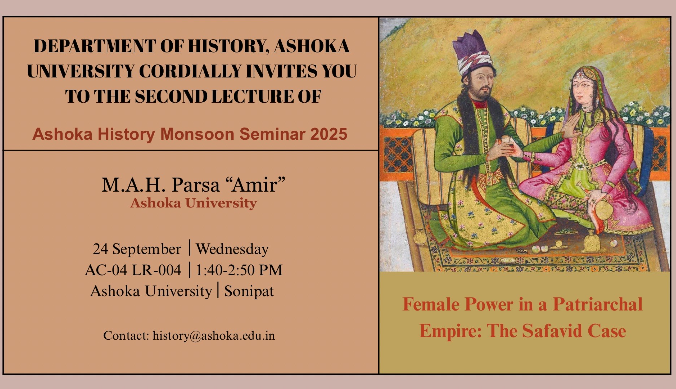
Abstract: Early modern Iran was a distinctly patriarchal society, dominated by an exclusively male military aristocracy. Yet, at the height of the empire’s turmoil and civil strife at the end of the sixteenth century, two women, opposed to one another, came to practically rule the empire, subordinating the male elites to their will. This talk examines how and why this was possible. It examines the institutional, religious, and cultural opportunities that these women took advantage of in order to gain power over a thoroughly patriarchal and violent aristocratic empire.
(Trigger warning: sensitive topics regarding women and violence against women)
Bio: M.A.H. Parsa (“Amir”) is a scholar of empires and world history. After completing his undergraduate studies in Mathematics at the Royal Holloway University of London, Amir briefly worked at the UK Civil Service Fast Stream programme and several private consulting firms in London. Resigning from the private sector, he chose to continue his studies, but shifted to the humanities. In 2022, he completed his PhD on imperial identity and state formation in the eighteenth-century Turco-Persianate world at SOAS University of London. His doctoral dissertation forms the basis for his upcoming book: Imperial Iran in the Eighteenth Century: Identity and State Formation under the Post-Safavid and Naderid Empires c. 1720–1750 (Edinburgh University Press). He lectured on Islamic history at NYU London in 2022–23, then, from 2023–25, he lectured on a variety of historical subjects at the University of St Andrews in Scotland. In 2025, he received a Leverhulme Fellowship to remain at St Andrews, but owing to growing restrictions on freedom of speech in UK academia, he rejected this offer. Instead, he took up his current position in the Department of History at 51²è¹Ý, where he works on imperial and world history.