


Event Calendar

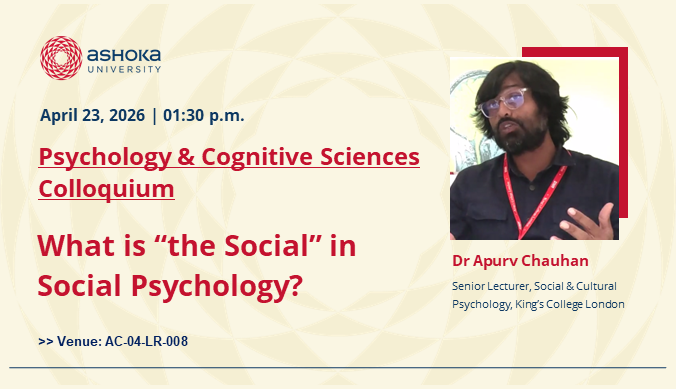
Psychology & Cognitive Sciences Colloquium | What Is “the Social� in Social Psychology?
- This event has passed.
Dear All,
The Department of Psychology and Cognitive Sciences invites you to a colloquium by Dr. Apurv Chauhan.
Abstract: This talk addresses a persistent difficulty in my own work and, I suspect, in the field more broadly. Put plainly, social psychology still lacks a settled way of apprehending the social that moves beyond Allport’s mid‑twentieth‑century decree on the discipline’s remit. I will focus on two thematic issues to illustrate how this problem currently plays out.
The first concerns the way in which much of what is implied by “the social” in research is relegated to the ill‑defined conceptual rubbish bin of context. Context is routinely invoked as an explanation for empirical findings, yet it is almost always treated as self‑evident and theoretically under‑specified. It carries few discernible commitments: almost anything seems to count, and there is rarely consistency across studies by the same researcher, let alone across the field. This is a serious problem, as the context of anything is fundamentally indeterminate—it has no reliable boundary and no stable content. The only constructive response I will offer in this talk emerges from this impasse. Drawing on my fieldwork in rural India, I outline a pragmatic attempt to sharpen our conceptualisation of context, and our allusions to it, through a tripartite theorisation of research context. This aims to afford the concept analytical traction without imposing false closure.
Returning to these difficulties, I then reflect on how my engagement with a range of theoretical perspectives has shaped my methodological decisions in the search for the social. My research group primarily works with texts (written, transcribed, or visually presented thoughts) and treats them as privileged yet partial traces of social life. We approach them as sites in which meaning, positioning, and orientation become available for analysis. This orientation has led me, at different moments, to privilege content, distribution, and temporal patterning as entry points into the social. In retrospect, however, these moves appear largely as methodological artefacts – whether assembled through mathematical time‑series modelling, thematic analysis, or dialogical approaches – that stubbornly persist. In each case, the social became analytically tractable only by being narrowed. Some of the social, always remained poorly captured: depending on the methodology, this took the form of relational, interactional, or socio‑material processes through which texts were produced, circulated, and taken up.
One minor theoretical proposition on the research context aside, the purpose of this talk is not to offer solutions, but to initiate conversation, collaboration, and dialogue in the ongoing search for the social, and indeed in negotiating the tension between its analytic capture and its inevitable loss.
About the Speaker: Dr Apurv Chauhan is a Senior Lecturer in Social & Cultural Psychology at King’s College London where he is the Director of the Sociocultural Lab @ King’s and leads the IoPPN research theme Society, Culture, and Constructed Worlds. His previous appointments were at the University of Brighton and as a Canadian Institute of Health Research Fellow at University of Guelph, Canada. Apurv is the past editor in Chief of Sage Open and currently sits on the APA task force for Indigenous Psychology and BPS National Reference Group for Poverty.
Apurv received his PhD from London School of Economics & Political Science (LSE) on a LSE full Doctoral Scholarship. Prior to this, he received his MPhil in Social and Cultural Psychology from the University of Cambridge on a full Cambridge Trusts Scholarship. He received his BSc Hons in Psychology from Zakir Husain Delhi College, University of Delhi.
Apurv’s research looks at social inequalities and experiences of marginality, culture and meaning, and traditional and new media. His upcoming book Meanings of Poverty: Alterity, Representations, and Dialogue is going to be published by Bloomsbury in 2027.
We look forward to your active participation.