


Event Calendar

Philosophy Colloquium: Karl-Stéphan Bouthillette
Philosophy as a Way of Life in Ancient India: Reading Texts as Practices of Transformation
- This event has passed.
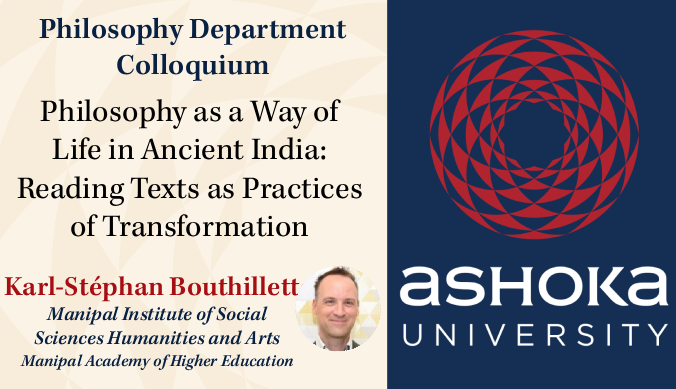
All are invited to a Philosophy Colloquium Talk on Thursday 20th November at 13:30 in AC01 LR105 by Karl-Stéphan Bouthillette, titled "Philosophy as a Way of Life in Ancient India: Reading Texts as Practices of Transformation."
Abstract: This talk reconsiders Indian philosophy through the lens of philosophy as a way of life—an expression famously revived by the French classicist Pierre Hadot to describe ancient Greco-Roman philosophical schools as communities of transformative practice rather than systems of abstract thought. Drawing on my recent book, Metaphysics as Therapy: List-Making and Renunciation in Gnostic Yogas (Springer, 2025), I extend this framework to the Indian context, showing how traditions such as SÄÂ�ṃkhya, Advaita VedÄÂ�nta, Buddhism, and Jainism likewise understood philosophy as a disciplined way of transformation.
In these traditions, metaphysical reasoning, taxonomic analysis, and dialectical negation were not speculative ends in themselves but spiritual exercises, means of cultivating viveka (discernment), dissolving false identifications, and internalizing renunciation as an act of self-sacrifice. The goal was not mere intellectual mastery but a radical shift in being: a withdrawal from the egoic and karmic mechanisms that sustain bondage.
By interpreting canonical texts as performative instruments of transformation—practices of thinking that enact the very liberation they describe—this talk proposes a practice-oriented hermeneutic of Indian philosophy. It argues that to read philosophically is already to practice a form of yoga: a contemplative discipline where metaphysical insight and ethical renunciation converge, offering a renewed understanding of philosophy as both therapy and soteriology.
Bio: Dr. Karl-Stéphan Bouthillette obtained his PhD (2018) in Indian Philosophies from the Institute for Indology and Tibetology of the Ludwig-Maximilians-Universität, in Munich, Germany. He is now Assistant Professor at the Department of Philosophy (DoP) at MAHE. He published extensively on the early developments of Sanskrit philosophical doxography and now researches on the phenomena of list-making and taxonomy within the spiritual exercises of South-Asian gnostic yogas. In general, he is exploring the ancient South-Asian intellectual dimensions of spiritual life, especially in the scholastic and ascetic aspects of their expression. In brief, he has taken interest in what he describes as the ‘yoga of reason’, or the ‘path of knowledge’ (jnana-yoga) pursued by Gnostics belonging either to the Hindu, Buddhist, or Jain traditions.