


Event Calendar

Living with Risk: Why Adaptation Matters Now More Than Ever
Guest Lecture, Environmental Studies
- This event has passed.
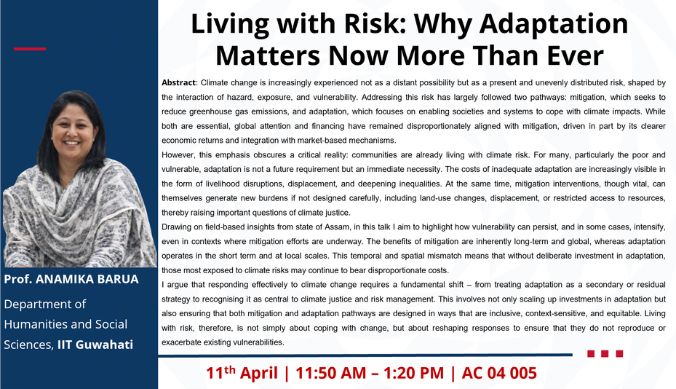
Dear All,
The Department of Environmental Studies cordially invites you to a guest lecture on Saturday, 11th April 2026.
Title: Living with Risk: Why Adaptation Matters Now More Than Ever
Speaker: Prof Anamika Barua, Department of Humanities and Social Sciences, IIT Guwahati Climate
Date: 2nd April 2026
Time: 11:50 AM – 1:20 PM
Venue: AC 04 005
Abstract: Climate change is increasingly experienced not as a distant possibility but as a present and unevenly distributed risk, shaped by the interaction of hazard, exposure, and vulnerability. Addressing this risk has largely followed two pathways: mitigation, which seeks to reduce greenhouse gas emissions, and adaptation, which focuses on enabling societies and systems to cope with climate impacts. While both are essential, global attention and financing have remained disproportionately aligned with mitigation, driven in part by its clearer economic returns and integration with market-based mechanisms.
However, this emphasis obscures a critical reality: communities are already living with climate risk. For many, particularly the poor and vulnerable, adaptation is not a future requirement but an immediate necessity. The costs of inadequate adaptation are increasingly visible in the form of livelihood disruptions, displacement, and deepening inequalities. At the same time, mitigation interventions, though vital, can themselves generate new burdens if not designed carefully, including land-use changes, displacement, or restricted access to resources, thereby raising important questions of climate justice.
Drawing on field-based insights from state of Assam, in this talk I aim to highlight how vulnerability can persist, and in some cases, intensify, even in contexts where mitigation efforts are underway. The benefits of mitigation are inherently long-term and global, whereas adaptation operates in the short term and at local scales. This temporal and spatial mismatch means that without deliberate investment in adaptation, those most exposed to climate risks may continue to bear disproportionate costs.
I argue that responding effectively to climate change requires a fundamental shift – from treating adaptation as a secondary or residual strategy to recognising it as central to climate justice and risk management. This involves not only scaling up investments in adaptation but also ensuring that both mitigation and adaptation pathways are designed in ways that are inclusive, context-sensitive, and equitable. Living with risk, therefore, is not simply about coping with change, but about reshaping responses to ensure that they do not reproduce or exacerbate existing vulnerabilities.
Speaker's Bio:
Anamika Barua is a Professor in the Department of Humanities and Social Sciences at the Indian Institute of Technology Guwahati, India. She is also affiliated with the Centre for Disaster Management and Research, the Centre for Environment, and the Centre for Sustainable Water Research. In 2021, she served as a Visiting Faculty member at the Asian Institute of Technology, Bangkok.
Trained in Ecological Economics, her interdisciplinary research focuses on sustainability transitions in the Global South. Her areas of interest include climate change and water security, water utilities and pricing, ecological footprints, virtual water flows through trade, and water governance, including transboundary water systems.
We look forward to your active participation in the talk.
warm regards,
Environmental Studies Department