


Event Calendar

28 Jan (Wed) 1:40 PM: First Lecture in Ashoka History Spring Seminar Series 2026
- This event has passed.
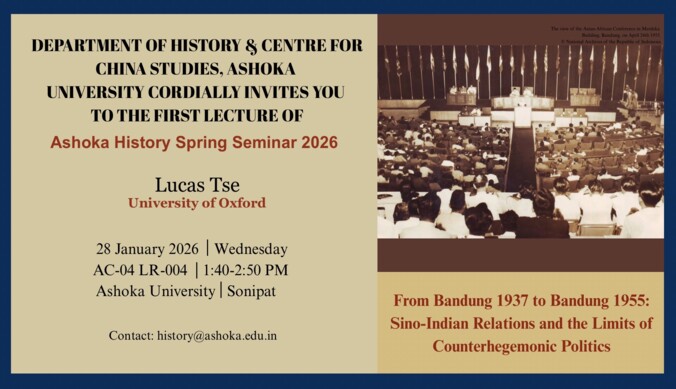
Abstract: This talk casts new light on Sino-Indian relations by tracing how representatives of the two countries interacted in international organisations and conferences. It situates these relations not only in bilateral terms but within a multifaceted and multilateral global stage. The historical narrative begins and ends with conferences located in neither country, but instead the third-party location of Bandung: the 1937 League of Nations conference, when Indian and Chinese delegations navigated tensions between intercolonial and anti-imperialist politics, and the more famous 1955 Bandung conference, which is often referenced as a starting point for decolonisation, but may also be seen as the last time that the world could imagine an Asian continent without a major Sino-Indian rivalry. The focus on interactions in international organisations and conferences provides a fresh empirical context to Sino-Indian relations, unearthing individuals and dynamics that are less apparent in bilateral diplomacy. It also enacts a methodological shift by interpreting Sino-Indian relations beyond a realist geopolitical framework, situating instead within the processes of postimperial nation-making that both countries underwent in this period. The two countries were major drivers towards a world after empire, and their relations pose significant questions about the possibilities and contradictions of counterhegemonic politics.
Bio: Lucas Tse is a postdoctoral researcher and Examination Fellow at All Souls College, Oxford. His research focuses on the international and economic history of modern China, and on Asian participation in global governance. He is especially interested in the entanglements of nationalist and internationalist movements, the emergence of global inequality as a political problem, and the non-linear transition from a world of empires to a world of nation-states. Tse received his PhD and MPhil from Oxford, where he was a Rhodes Scholar. His doctoral thesis examined relations between China and international organisations in the mid-20th century.