


Event Calendar

04 Feb (Wed) 1:40 PM: Second Lecture in Ashoka History Spring Seminar Series 2026
- This event has passed.
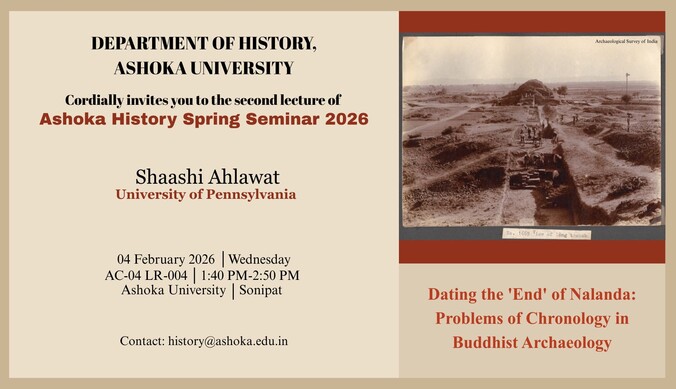
Abstract: This talk revisits the long-accepted chronology of Nalanda MahÄÂ�vihÄÂ�ra, a timeline that continues to be shaped by colonial-era assumptions. Nalanda's traditional dating—derived largely from Xuanzang and the colonial-era framework of civilizational collapse with the advent of Islam in India—was established long before the site was excavated, and early twentieth-century archaeologists interpreted their findings through this inherited framework. Drawing on ASI reports and early excavation photographs, the talk examines how this interpretive scaffolding constrained the reading of Nalanda's material record and contributed to distorted understandings of its later history. By reassessing the site's archaeological evidence alongside comparable regional Buddhist sites, the talk argues that Nalanda's trajectory was far more extended and complex than assumed. The talk highlights broader methodological issues in Buddhist archaeology and calls for more nuanced approaches to the study of Buddhist archaeological sites in South Asia.
Bio: Shaashi Ahlawat is a historian of premodern South Asia working at the intersections of religion, polity, and regional histories. She recently completed her Ph.D. in South Asia Regional Studies at the University of Pennsylvania, where her dissertation offered a new interpretation of Buddhism's decline in Eastern India. Her first book project, The Weight of Ruins: Nalanda, Odantapuri, and the Decline of Indian Buddhism, grows out of her doctoral work, alongside new projects on the rise of early medieval Buddhist mah�vih�ras and on Jain pilgrimage networks in Jharkhand. Her research has been supported by the ACLS/Robert H. N. Ho Foundation and the American Institute of Indian Studies.
Looking forward to having you with us.
Yours sincerely,
The History Faculty